

- Agreement formalises financing for water infrastructure framework.
- Key wastewater treatment facilities to be constructed under project.
- Declaration signing underscores momentum in Pak-EU cooperation.
Pakistan and the European Investment Bank (EIB) on Wednesday signed a €60mn declaration to advance a major project aimed at improving sewage and wastewater management in Karachi.
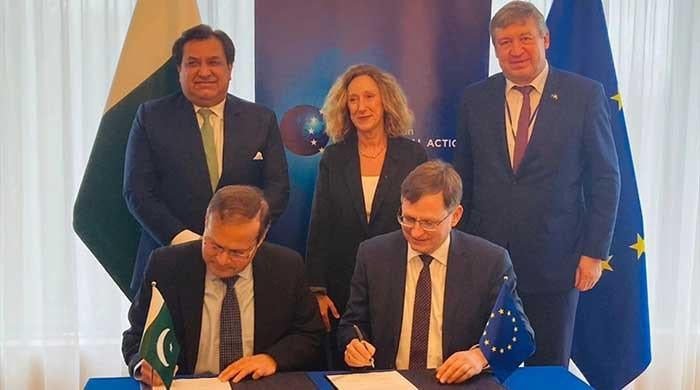
The declaration was signed on the sidelines of the 15th Pakistan-European Union Joint Commission, being held in Brussels from December 15–17, by Ministry of Economic Affairs Secretary Muhammad Humair Karim, and European Investment Bank (EIB) Head of Division (Asia Pacific) Edvardas Bumsteinas.
The signing ceremony was witnessed by European Commission Deputy Director-General for International Partnerships Myriam Ferran, Ambassador of Pakistan to the European Union Rahim Hayat Qureshi, head of the EU delegation to Pakistan Raimundas Karoblis, and European External Action Service (EEAS) Acting Managing Director Paola Pampaloni.
The agreement formalised EIB financing for the Karachi Water Infrastructure Framework project that will support the rehabilitation and construction of key water treatment facilities in Karachi.
With an EIB financing package of approximately €60 million, this initiative is set to significantly expand safe water supply and enhance water security for Karachi’s rapidly growing population.
The project reflects Pakistan’s commitment to modernising essential urban services and promoting climate-resilient infrastructure in one of the country’s largest metropolitan areas.
Speaking at the signing, Karim welcomed the EIB’s increased engagement in Pakistan and underscored the importance of deepening cooperation with European partners to address critical development and infrastructure needs.
He expressed appreciation for the EIB’s growing footprint in Pakistan and conveyed Pakistan’s interest in expanding the pipeline of EIB-supported projects in priority sectors.
The signing demonstrates the continued momentum in Pakistan-EU cooperation and highlights shared priorities in sustainable development, public service delivery, and climate and environmental resilience.

