


Expert urges quake preparedness for Karachi, says city sits near three-plate junction and multiple fault lines
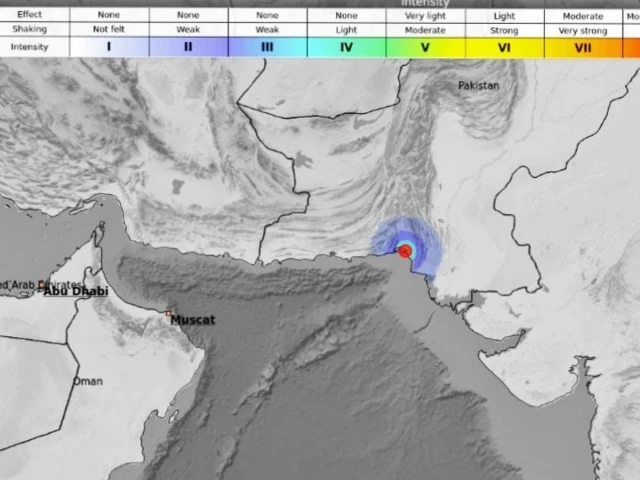
A 5.2-magnitude earthquake that struck Karachi on Tuesday night originated in the Sonmiani area of Hub district, where three tectonic plates—the Arabian Plate, the Eurasian Plate, and the Indian Plate—meet. This fact necessitates precaution on the part of Karachi residents.
Tectonic plates are massive, irregularly shaped slabs of solid rock that make up Earth’s lithosphere—crust and upper mantle—and slowly move over the asthenosphere—semi-molten rock beneath them—driven by internal heat.
Speaking to The Express Tribune, National Seismic Centre Director Ameer Haider Laghari said the earthquake was caused by a movement in the Arabian Plate at the junction.
Read: 5.2 magnitude earthquake reported in Karachi
“As a result, tremors and vibrations were felt in many areas of Karachi. Fortunately, the intensity and depth of the earthquake were low,” he said, adding that the location near Sonmiani where the earthquake originated also has no human settlement.
According to Laghari, this was not the first time an earthquake of this magnitude—slightly higher on the Richter scale than recent past tremors—had been recorded.
However, he warned, this does not mean that people should become completely complacent. Earlier, a 5.0-magnitude earthquake was recorded in 2020 as well.
He said the fault lines and tectonic boundaries near Karachi are mostly located at shallow depths, where very high-intensity earthquakes have never been recorded.
A fault line is a fracture or zone of fractures in the Earth’s crust where blocks of rock move relative to each other, releasing stress as earthquakes or slowly through creep.
Karachi sits near several active fault lines, including the local Landhi fault, Malir fault, and the nearby Hub fault—influenced by the tectonic boundary of the Arabian, Indian, and Eurasian plates.
Also Read: Govt to tighten monitoring of trade in precious metals to curb money laundering, terrorist financing
Experts identify around five active fault lines in the vicinity, with recent minor tremors often releasing energy along the Landhi-Korangi fault.
Laghari stressed that whether an earthquake occurs in the sea in the form of a tsunami or on land, basic preparedness training is extremely important, and earthquake-resistant construction is equally essential, requiring special focus.
According to him, a micro-level study regarding earthquakes in Karachi has also been conducted during the current year. “During this study, a number of earthquakes were recorded on the Richter scale although people could not feel them due to their low intensity,” he said.
The expert said earthquakes were also recorded here in the 18th and 19th centuries; however, modern instruments were not available at that time, so their intensity was not recorded
Earlier, there were forests and orchards along the fault lines, but now vast areas are densely populated—a fact, which Laghari said, must be kept in mind while making plans for preventing earthquake related incidents.
He pointed out that people in Japan also live near fault lines, but their construction practices take this natural process into account.
Read: Three terrorists killed in CTD operation in Peshawar
“There is a need to formulate a proper policy to ensure that construction near fault lines is earthquake-resistant, or that construction and civil works meet standards capable of withstanding earthquakes,” he said.
During the middle of the current year, 57 earthquakes were recorded over a period of 23 days along the Korangi–Landhi fault line, whereas in 2009, approximately 36 earthquakes were recorded over a period of four months.

