


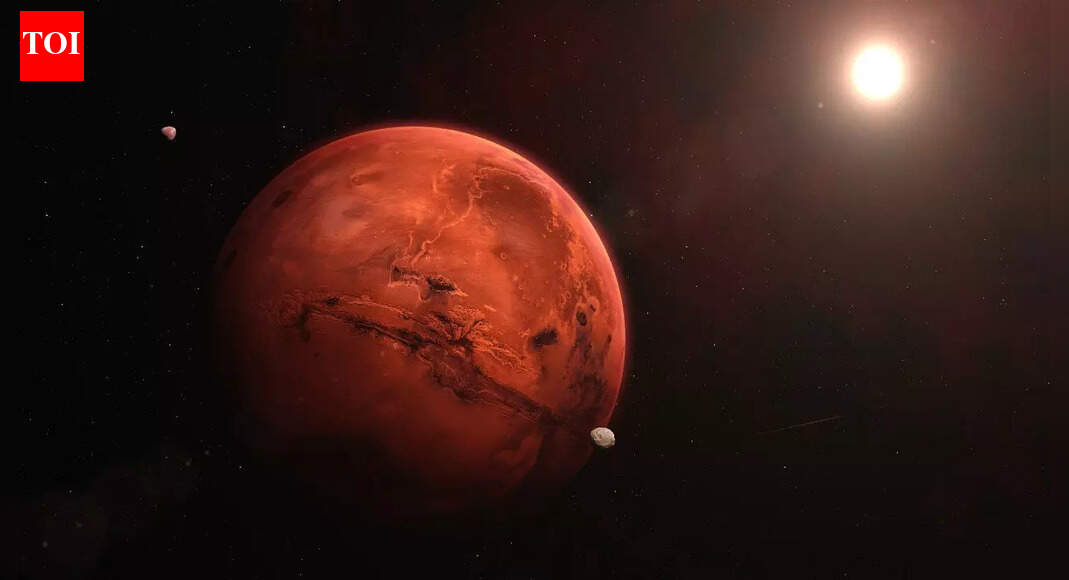
The idea sounds dramatic, almost clickbait-level dramatic. Is Mars controlling Earth’s climate? It feels wrong on instinct. Climate change is something we argue about in terms of cars, coal, forests, and oceans, not dusty planets hanging millions of kilometres away. And yet, Earth is not floating alone in space. It is part of a system where every object pulls on every other object, quietly, constantly, whether we pay attention to it or not.That is where Mars enters the conversation. Not as a puppet master, not as some hidden switch, but as one of many bodies whose gravity nudges Earth’s path over very long stretches of time.Scientists started piecing this together long before climate change became a political word. When researchers looked at ice cores and ocean sediments, they noticed repeating climate patterns that stretched back hundreds of thousands of years. These patterns did not match volcanic eruptions or solar flares. They matched changes in how Earth moves around the Sun. A peer-reviewed study published in the journal Science showed that major climate shifts line up with predictable changes in Earth’s orbit and tilt caused by gravitational interactions within the solar system. Mars is part of that system.
What Mars is actually doing, and what it is not
Mars is not sending heat to Earth. It is not interacting with our atmosphere. There is no energy beam, no magnetic link, no physical exchange. The influence is purely gravitational, and it is weak. But weak does not mean meaningless when you give it tens of thousands or millions of years to work.Every planet tugs on every other planet. Most of the time, nothing noticeable happens. But over long periods, those tiny pulls slightly alter the shape of Earth’s orbit and the way its axis behaves. Climate reacts strongly to those details.
Why Earth’s orbit matters so much for climate
Earth’s climate is sensitive to how sunlight is distributed, not just how much sunlight exists. Small shifts in orbit can change whether summers at high latitudes are cool enough for ice to survive or warm enough to melt it. That difference decides whether ice sheets grow or retreat.Earth’s orbit slowly stretches and relaxes. Its axis tilts a little more, then a little less. It wobbles. These movements are slow, predictable, and repeat over long cycles. Mars helps influence the timing of some of these shifts.
The role of Mars among the planets
Jupiter does most of the heavy lifting when it comes to gravity, but Mars sits closer to Earth and affects finer details of Earth’s orbital shape. Scientists studying long climate records noticed that models become more accurate when Mars is included.This does not mean Mars drives the system. It means it nudges the clock.
Why do people misunderstand the Mars climate link
The problem is scale. Planetary effects work on timescales humans struggle to intuit. Thousands of years. Tens of thousands. Millions. When headlines collapse that into present-day climate change, it creates confusion.Mars has nothing to do with modern global warming. The temperature rise happening now is far too fast. Orbital changes are slow. Human activity is fast.
Why scientists still care about this research
Understanding orbital influences helps scientists avoid mistakes when reading Earth’s climate past. If you do not account for natural long-term cycles, you can misinterpret data. It also helps researchers understand why ice ages appear and disappear in a rhythm that existed long before humans.This research is not about blame or denial. It is about context.
So, is Mars controlling Earth’s climate
No. Mars is not controlling anything. It is not steering Earth. It is not deciding outcomes.What Mars does is contribute, quietly, mathematically, almost invisibly, to the slow background rhythm of Earth’s movement through space. Climate responds to that rhythm over geological time.The real story is not about Mars at all. It is about how Earth’s climate is shaped by forces both close and unimaginably distant, some loud and immediate, others patient enough to wait millions of years to leave their mark.Also read| NASA scientist revisits the Star of Bethlehem mystery with a new cosmic explanation

