


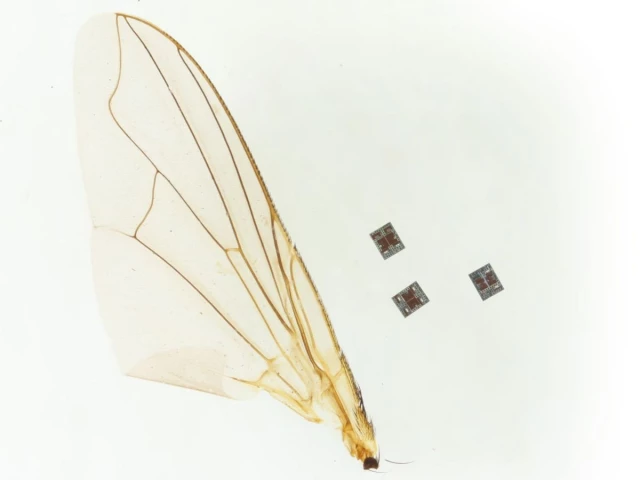
Powered by tiny solar cells and a glass-like coat, the robot works independently without control
The robot compared with insects wing. PHOTO: Maya Lassiter / Miskin Lab / University of Pennsylvania
Scientists in the United States have developed a robot smaller than a grain of salt that can sense, think and act on its own, marking a breakthrough that researchers say solves an engineering challenge dating back more than four decades.
Teams from the University of Michigan and the University of Pennsylvania have created the microscopic machine, which integrates computing, sensing and movement in a form previously considered impossible at such a scale.
The robot contains a 55-nanometre computer, temperature sensors accurate to within 0.3 degrees Celsius, and tiny motors that allow it to move through liquid using platinum electrodes.
The robot contains a 55-nanometre computer, temperature sensors accurate to within 0.3 degrees Celsius. PHOTO: Michael Simari/University of Michigan
Powered by miniature solar cells and protected by a glass-like coating, the robot operates independently without external control. Lead researcher Marc Miskin described it as the first tiny robot able to “sense, think and act”, a claim supported by its technical capabilities.
Researchers say the technology could have far-reaching medical applications, including targeted drug delivery through the bloodstream, repairing damaged nerves and monitoring cell health in real time. According to the scientists, practical medical uses could emerge within the next 10 years as the technology advances beyond laboratory testing.
David Blaauw of the University of Michigan said the robots are already showing signs of real-world potential, though significant challenges remain. The devices must be made biocompatible and adapted to function in environments such as saltwater or on land, rather than the freshwater conditions used in current experiments.
Despite their sophistication, the robots do not require expensive equipment to operate. Researchers noted that high school students were able to control them using a basic $10 microscope, highlighting their accessibility.
Looking ahead, scientists aim to develop swarms of these micro-robots that can communicate and work together, potentially revolutionising surgical procedures. Johns Hopkins University researcher David Gracias has suggested that, over the next century, such robots could even replace human surgeons, though he acknowledged that regulatory and technological hurdles remain substantial.

