


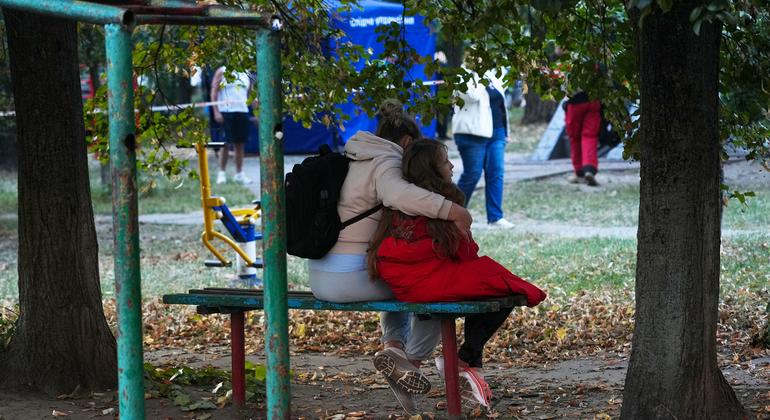
“Our findings establish several worrying trends: rising civilian casualties in both frontline and urban areas, sustained attacks on energy infrastructure, and continued patterns of systematic and widespread torture and ill-treatment of Ukrainian prisoners of war and civilian detainees,” said Danielle Bell, head of the Human Rights Monitoring Mission in Ukraine (HRMMU),
Russia launched its so-called “special military operation” in Ukraine on 24 February 2022, and the report covers the period from 1 June to 30 November 2025.
Surge in civilian casualties
It reveals that civilian casualties surged in both frontline and urban areas, with July marking the highest number of civilian deaths and injuries since April 2022.
A total of 1,420 civilians were killed and 6,545 injured during the reporting period – a 12 per cent increase over the same period a year earlier and a nearly 40 per cent increase over the prior six months.
Casualties included 61 medical workers, 99 emergency service personnel, six media professionals, and 13 humanitarian workers.
Western Ukraine also experienced its deadliest attack since the invasion began, when a large-scale combined drone–missile strike killed at least 36 civilians in Ternopil on 19 November.
Deteriorating conditions on the frontlines
Frontline regions have experienced a severe deterioration in living conditions, as short-range drones, aerial bombs, and other munitions caused extensive damage to residential buildings and other vital civilian infrastructure. Some areas were left uninhabitable, forcing residents to seek shelter elsewhere.
Additionally, many hospitals and clinics in frontline towns were destroyed or forced to close, leaving residents without access to basic healthcare.
This was compounded by disruption of water, heating, and electricity, which particularly impacted older people and persons with disabilities.
Damage to Ukraine’s power infrastructure has lad to led to disruptions in essential services like electricity, heating, and water supplies. (file)
Energy grid attacked
During October and November, Russia launched eight large-scale, coordinated waves of missile and drone attacks targeting Ukraine’s energy system, which caused emergency power outages and daily electricity cuts in multiple regions.
Scheduled power cuts lasted up to 18 hours per day, with interruptions in water services and heating for many hours or days in some areas.
Record prisoner exchange
Ukraine and Russia also carried out the largest exchange of prisoners of war (POWs) since 2022, with the sides releasing more than 3,000 people. However, HRMMU observed no improvements in the treatment of those interned.
“Systematic and widespread torture and ill-treatment of POWs is one of the most shocking and pervasive features of this war,” Ms. Bell remarked.
A Ukrainian POW spoke about how he was treated in a pre-trial detention facility in Russia.
“During my whole time in the facility, we were beaten almost every day. The guards beat us almost every time we were leaving the cell for an inspection or to go to the medical unit or shower,” he told investigators.
“Several times I was beaten so badly that my body hurt for weeks.”
Limited care, extrajudicial executions
Russia recently freed 187 Ukrainian POWs and “185 provided accounts of severe beatings, stress positions, electric shocks, suffocation, dog attacks and, in many cases, sexual violence,” Ms. Bell said.
“Interviewees also described harsh conditions of detention, limited medical care, and violence occurring during capture, transfer, admission to new facilities, and throughout internment,” she added.
Monitors also interviewed 137 POWs held by Ukraine, including 10 nationals of third countries. More than half provided accounts of torture and ill-treatment during interrogation or transfer, before arrival at official internment facilities.
“I knew nothing, but they kept torturing me even more,” a Russian POW said about his experience during interrogation in a transit place
The report also documents a rise in extrajudicial executions of POWs. At least four incidents involving the killing of 10 Ukrainian servicepersons after capture by Russian forces were assessed as credible.
Four executions of Russian POWs by Ukrainian armed forces were also recorded, alongside credible allegations of three additional incidents currently under review.
Life under occupation
Meanwhile, authorities in Ukrainian territory under Russian occupation continued to impose measures in violation of international humanitarian law, with worsening restrictions on freedom of movement, expression, religion, and access to independent information.
In March, Russia issued a decree which set a 10 September deadline for Ukrainian citizens in these areas to get a Russian passport, residence permit or other document to “legalise” their stay or risk deportation.
Patterns of arbitrary arrest, prosecutions for criticism of the “special military operation”, the use of forced confessions, and the retroactive application of criminal laws.
The report highlights the continued efforts of the Ukrainian authorities and humanitarians to support civilians, including large-scale evacuations, establishment of transit centres, and delivery of medical, psychosocial, and legal assistance.
This is taking place despite extremely challenging and increasingly dangerous conditions, including attacks on humanitarians.

