


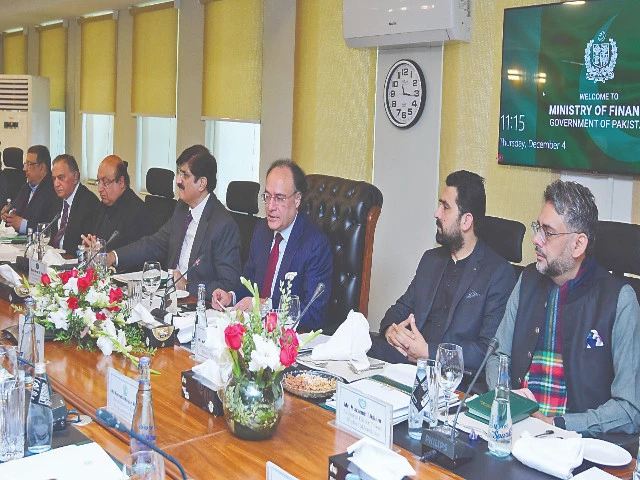
All five stakeholders agree on establishing a committee to finalise modalities for increasing provinces share
Flanked by Sindh Chief Minister Murad Ali Shah and K-P Chief Minister Sohail Afridi and others, Finance Minister Muhammad Aurangzeb speaks during a meeting of the National Finance Commission. Photo: Express
ISLAMABAD:
Sindh on Thursday linked consensus on any new resource distribution formula with deliberations only at the National Finance Commission platform and sought to limit discussions to revenue sharing instead of bringing expenses in the fold amid the Centre’s desire to transfer some of its fiscal obligations.
The maiden meeting of the NFC kick started on a positive note and all five players gave commitments to achieve consensus with an open mind. However, there were also differences of opinion on what should be discussed in the NFC, according to the participants of the meeting.
The inaugural meeting of the 11th NFC was chaired by Finance Minister Muhammad Aurangzeb and Khyber-Pakhtunkhwa registered the first win.
All the five stakeholders agreed on establishing a committee to finalise modalities for increasing the share of the war-torn province in the resources on account of merger of 6.1 million population of erstwhile FATA in the province.
Contrary to the Centre’s earlier desire to settle the resource distribution issue through a new constitutional amendment by scaling down the minimum share of the province from 57.5%, Sindh and Khyber-Pakhtunkhwa emphasised to discuss this issue only at the NFC platform.
“Syed Murad Ali Shah underscored that consensus can only be developed by deliberating within the forum of the National Finance Commission and that this Commission should adhere to its mandate in order to move forward,” according to a consensus statement released by the Ministry of Finance after the meeting.
KP has already stated that the NFC matters should be dealt by the NFC.
The Sindh objected to the federal government’s proposal on discussing the expenditures at the NFC platform and said that the discussions should focus only to the extent of revenues, said Muzzammil Aslam, the finance advisor of KP after the meeting.
However, the Finance Ministry proposed the way forward of devolving the expenditures to the provinces and also increasing the revenue generations. Sindh province did not want to discuss the issue of expenses and urged to keep the discussions focused on revenues.
The federal government said that both the Centre and provinces should cumulatively increase their revenue collections by about 6% of the GDP. The chairman FBR Rashid Langrial also suggested that the provinces should increase their meager collection from 0.8% of the GDP to 3%. He further said that the federal taxes should also go up by 3.5% to 14% of the GDP by 2028.
The additional 5.5% of the GDP fiscal space translates to roughly Rs7 trillion at today’s size of the economy and can resolve the fiscal woes of the Centre.
The federal government showed that its fiscal situation has significantly deteriorated and the overall budget deficit widened from pre 2010 level of 4% to 7% of the GDP from 2011 to 2025.
The official handout stated that Aurangzeb highlighted the constitutional importance and collaborative spirit underpinning the NFC process.
The federal finance minister stressed the government’s commitment to transparent and sincere dialogue. Senator Aurangzeb underscored the critical role of the NFC in ensuring equitable distribution of financial resources, promoting fiscal sustainability and supporting long-term economic growth. He voiced confidence that the Commission would engage in meaningful and inclusive dialogue aimed at delivering a fair and forward-looking NFC Award.
The Chief Minister Khyber Pakhtunkhwa Sohail Afridi expressed that a strong federation and strong provinces will guarantee a strong and united Pakistan. He underscored the sacrifices of the people of Khyber Pakhtunkhwa province made in the War on Terror, which unfortunately has resurfaced again.
Afridi further expressed the hope that the 11th NFC will address the ultra vires of the 7th NFC since June 2018 and include the population and other variables of the Newly Merged Districts in the province of Khyber Pakhtunkhwa and update the share of the province to give them due representation and requested the other provinces for their positive response in this matter.
The Finance Ministry announced that “it was also unanimously decided that a sub-group on the merger of former FATA/ Newly Merged Districts, and its share in the divisible pool, will be constituted which will facilitate early formulation of its recommendations for the NFC by mid-January 2026”.
The NFC also constituted half a dozen other working groups that would deliberate on vertical distribution of resources, horizontal distribution of resources and the variables for deciding the shares of the provinces.
Punjab’s Finance Minister Mian Mujtaba Shuja ur Rehman said that consensus building will take a lot of effort on everyone’s part. He emphasized that importance of equitable resource distribution and consistency of policies between the federal and provincial governments.
Mir Shoaib Nosherwani, Balochistan Finance Minister, voiced to achieve consensus and that cooperation of Balochistan with the federation and the provinces has always been there and going forward, Balochistan will continue this path of cooperation and consensus.
The Commission also discussed the proposed schedule and timeline for future meetings and agreed to initiate the formation of technical sub-groups that will undertake work on specific mandates relevant to the NFC’s functions.
The Commission resolved to continue its work through a structured series of meetings and technical consultations in the coming months, with the shared objective of achieving an equitable and sustainable NFC Award for the people of Pakistan.
In its presentation, the KP government said that the 11th NFC award should update the 7th NFC from June 2018 to bring it in compliance with the constitution. It should not only revise KP’s NFC share upward by including the population, poverty and other dynamics of the merged districts in Khyber Pakhtunkhwa but also account for the difference during the period 2019-20 to 2025-26 which was not given to the province, according to the proposal.
The KP government also demanded that its share of war on terror should be tripled to 3% due to recent uptake in terrorist incidents and high poverty levels in the province.
Khyber-Pakhtunkhwa Chief Minister Sohail Afridi said the federal government owes the province Rs1.3 trillion under the NFC and highlighted that the former tribal districts, merged administratively in 2018, have not yet been financially integrated.
The KP government said that the province’s share in total overseas workers registered is more than 30% of the total Pakistani workers registered abroad. Given that KP share in total population of Pakistan is only about 17%, the significantly larger share of KP workers seeking employment abroad points towards lower employment opportunities in the province as compared to the rest of Pakistan but earning foreign exchange for Pakistan.
It also added that the 18.8% of the total household income in Khyber Pakhtunkhwa comes from foreign and domestic remittances as compared to the national average of 8.6%.

