


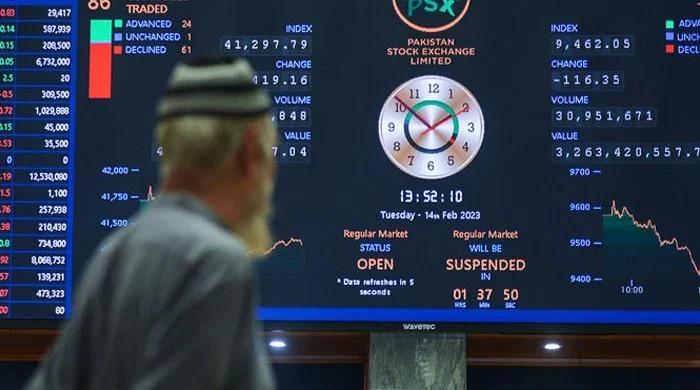
Stocks rebounded with a vengeance on Wednesday, erasing nearly all of the last session’s sharp losses as political tensions eased after Pakistan Tehreek-e-Insaf (PTI) decided to “shelve” its three-day protest in Islamabad.
The rally signalled a dramatic shift in investor sentiment, with the Pakistan Stock Exchange (PSX) roaring back to life amid restored confidence and reduced fears of prolonged instability.
The Pakistan Stock Exchange’s (PSX) benchmark KSE-100 Shares Index shot up by 3,740.84 points, or 3.96%, reaching 98,315.19 points during the intraday trade, up from the previous close of 94,574.16 points.
The market suffered an over 3,500-point crash on Tuesday after PTI’s march on Islamabad turned violent, with angry protesters clashing with riot police and resulting in the martyrdom of at least three Rangers and two police personnel, according to government officials.
Meanwhile PTI has claimed that eight of its members lost their lives.
Muhammad Sohail, CEO of Topline Securities, explained the rapid recovery: “The market is completely back to normal because. With reports confirming the protests had ended, investors who were selling yesterday are now in a buying mood.”
“Within 10 minutes of trading, the index surged, recovering the approximate Rs 450-500 billion market loss incurred on Tuesday,” he added.
Projecting cautious optimism down the line, Sohail said it would take a few more days for the market to fully stabilise, as investors were treading eggshells about rebuilding their positions after Tuesday’s tailspin.
“According to our report, we anticipate that the market could reach 127,000 points next year.”
While predicting when the market will cross the 100,000 mark remains a challenge, the Topline executive said that this milestone was quite likely to be achieved this month or the next, given the current trends.
The rally came in response to PTI’s announcement to temporarily call off its “do-or-die” protest, which had paralysed the federal capital since November 24.
The suspension followed a crackdown by law enforcement agencies, which dispersed protesters from Islamabad’s Red Zone.
In a press release by its central media cell, PTI stated: “In light of the government’s brutality and plans to turn the federal capital into a “slaughterhouse” for unarmed citizens, we are announcing the temporary suspension of our peaceful protest.”
The party added that future actions would be announced after consulting Imran Khan.
The easing of political unrest prompted a relief rally as investors, previously wary of prolonged instability, regained confidence and re-entered the market.
Muhammad Saad Ali, Director of Research at Intermarket Securities, attributed the market’s performance to improved investor sentiment: “The market is staging a relief rally today, following the news that the PTI protests have been quelled by the government. The market pared yesterday’s big losses almost completely.”
“Banks are supporting the rally too,” he added. “Yesterday’s removal of MDR on certain non-individuals deposits is a big positive for the large conventional banks—likely to support their earnings and payouts in 2025 amid falling interest rates.”
The banking sector emerged as the key driver of the rally, benefiting from the State Bank of Pakistan’s (SBP) removal of the Minimum Profit Rate (MPR) requirement on deposits from financial institutions, public sector enterprises, and public limited companies.
This decision, announced on Tuesday, has bolstered conventional banks by easing the burden of mandatory deposit reserves and improving profitability.
Previously, commercial banks were required to pay a minimum profit rate on all savings deposits, linked to the SBP repo rate. The removal of this requirement marks a shift in banking policy, aimed at facilitating large depositors and encouraging fair banking practices.
Analysts predict that the removal of the MPR will strengthen earnings and payouts for major banks in 2025, particularly as interest rates decline.
Additionally, the reversal of arbitrarily imposed charges on large accounts with deposits exceeding Rs1 billion has provided further relief to depositors.
The SBP’s decision aligns with its efforts to promote transparency and protect the interests of both banks and depositors.
By relaxing these requirements, the central bank aims to create a more balanced and competitive banking environment.
This is a developing story and is being updated with more details.

